
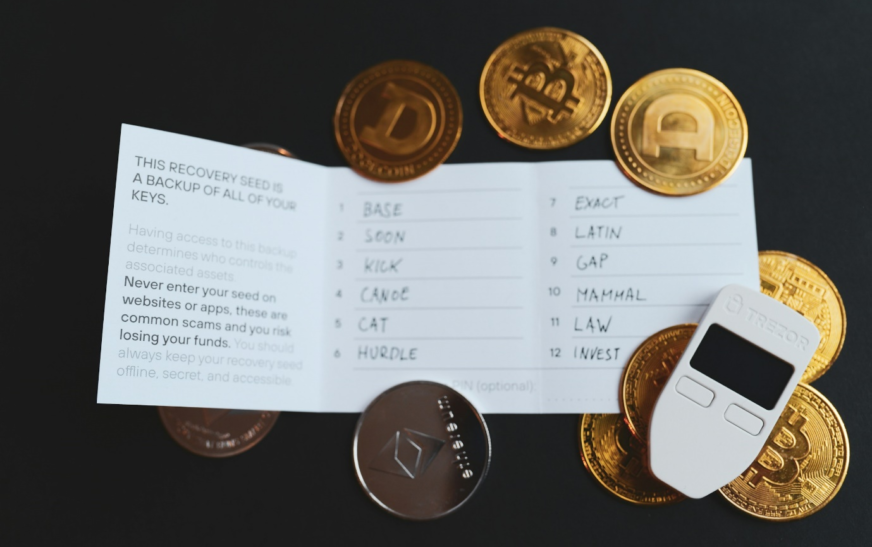
If you lose your seed phrase and your phone dies with it, the coins in that wallet are gone, and no company can bring them back. The phrase is 12 or 24 ordinary words that encode the master key to a self-custody wallet, and nobody keeps a copy for you.
People lose them to a cracked phone, a thrown-out notebook, or a scammer who asks them to “verify” the words. The fix is to know what the phrase is, back it up in a way that survives accidents, and decide whether you want the job at all.
A seed phrase is one huge random number written in words
Your wallet does not store coins. It stores keys that prove you control addresses on a blockchain, and those keys come from a single secret number. The seed phrase is that number translated into words a human can write down. The standard most wallets follow is BIP-39, a Bitcoin Improvement Proposal dated September 2013 and listed as deployed, whose stated goal is a sentence that “could be written on paper or spoken over the telephone”.
Here is how BIP-39 builds the phrase. The wallet generates between 128 and 256 bits of random data. It takes a fingerprint of that data (the first few bits of a SHA-256 hash) and attaches it as a checksum. It then cuts the whole thing into chunks of 11 bits, and each chunk, a number from 0 to 2,047, picks one word from a fixed list of 2,048 words.
A 12-word phrase therefore carries 2^128 possible secrets, about 3.4 × 10^38 combinations. That is why guessing a phrase by trying words is not a practical attack, and why the real threats are loss and theft, not clever mathematics.
To turn the phrase into a working wallet, BIP-39 runs the words through a key-stretching function (PBKDF2 with HMAC-SHA512, repeated 2,048 times) to produce a 512-bit seed. Standard wallet software then derives all your keys and addresses from that seed in a fixed order.
This is why the same 12 words restored in a different wallet app will usually bring back the same addresses.
Self-custody puts the phrase in your hands; accounts put a company there
The first thing to settle about any wallet is who holds the phrase. In a self-custody wallet, you do, and recovery is entirely your job. In an account-based service, a company holds the keys, and you prove who you are with a login, two-factor authentication (2FA), and sometimes identity checks.
Neither model is free of risk. With self-custody, nobody can freeze or lock you out, but a lost phrase is final and a stolen phrase gives a thief everything.
With an account, recovery is a support process, which is kinder to forgetful people, but you rely on the provider’s security and on the security of your own phone number and email. Most crypto wallets in Nigeria, like Breet, are account-based.
Breet is a crypto-to-cash and payments platform for users and businesses in Africa, not a wallet for long-term storage. Instead of keeping coins behind a seed phrase, you send crypto to a deposit address, and Breet converts it to naira or cedis at the rate shown before you confirm, with optional Automatic Settlement to a bank account or, in Ghana, mobile money. It suits people who want to convert, not hold.
That distinction is useful for people who receive crypto as payment and do not want to carry a recovery phrase around. Converting on arrival means there is no phrase to lose for that portion of your money, though the trade-off is that you no longer hold the crypto.
No one can recover a phrase you lose
The conversion runs one way. BIP-39’s own text lists it among the known shortcomings: because the seed is made by hashing the phrase, you can go from sentence to seed but not back. There is no server holding your words, no reset email, and no support desk with a master list. The phrase is the account.
The checksum does less than people assume. It is only a few bits long, so BIP-39 notes that it catches most typing mistakes but misses roughly 1 in 256 random errors, and it cannot correct them. It exists to warn you that a phrase was typed wrong, not to rescue a lost one.
There is one case where the arithmetic helps.
Say you remember 11 of 12 words and know where the gap is. Of the 2,048 words that could fill it, only about 128 produce a valid checksum (2,048 ÷ 2^4, because 4 bits of the phrase are checksum). A technically skilled person could test those 128 candidates against known addresses.
That is my own arithmetic from the specification, not a promise: it only works when you are missing a single known word and have an address to check against. Lose several words, or the whole phrase, and the possibilities explode.
BIP-39 also lets you add an optional passphrase, sometimes called the “13th word”. The specification says an empty string is used when none is set, and that every passphrase generates a valid wallet, so only the correct one opens the wallet you intended. That is a strong protection if someone finds your words, and a trap if you forget the passphrase, because the phrase alone then opens a different, empty wallet.
Back it up so that fire, thieves and forgetfulness all fail
There are six things a backup must survive: losing the device, remote theft (someone finding the phrase online), physical damage, theft by an in-person finder, a disaster at the storage site, and next-of-kin being unable to find it. Use that list as a test of any plan you make.
The guide sets out backup levels, and the advice scales with what is at stake.
| Level | Method | Protects against | The guide’s suggested use |
| 0 | Encrypted password manager | Losing the device | Small amounts, quick setup |
| 1 | Words written on card in permanent ink, stored at home | Device loss, online theft | Small amounts |
| 2 | Words stamped or engraved on metal | The above plus fire and water | Above a month’s salary |
| 3 | Offline backup plus a passphrase kept separately | The above plus theft on discovery | Larger amounts |
| 4 | Several copies in different places, passphrase protected | The above plus a local disaster | Larger amounts |
Three habits matter more than the level. Write the words numbered and in order, because order is part of the secret. Never photograph the phrase or type it into a notes app, email or cloud document, since the guide specifically lists screenshots saved to photo libraries and plain text on devices as things not to do.
And tell one trusted person that a backup exists and where the instructions are, without handing over the words, because the guide warns that without documentation there is a very high chance next-of-kin cannot recover funds.
The guide advises against splitting a phrase into pieces for storage because it adds failure points, so one well-protected copy plus a second location usually beats a clever scheme.
Anyone who asks for your phrase is robbing you
A phrase is the key itself, which means no legitimate support agent, airdrop, or “wallet validation” page ever needs it. If a message asks you to type your words into a website to fix, sync or verify a wallet, the page is built to copy them. The same rule covers messages that claim to be from your wallet’s team and DMs from “helpers” who find you after you post a question publicly.
Typing a phrase into any device you do not fully control carries the same risk. A phrase that has been on a screenshot, a cloud note, or a shared computer should be treated as exposed: create a new wallet and move the funds.
What a loss means under each model
The consequence of a lost phrase depends entirely on where the keys live. With self-custody, a lost phrase plus a dead device means a permanent loss, and a stolen phrase means someone else can empty the wallet from anywhere in the world within minutes, with no chargeback. With an account-based service, a lost password or phone is an inconvenience you can usually resolve through the provider’s recovery process, although that process may involve identity checks and waiting time. Neither is automatically safer. The question is which failure you are better equipped to prevent: your own record-keeping, or a company’s security and your own login hygiene.
What to do if you think you have lost it
Start with the free fixes, in order. Check where you may have stored it: a password manager, old phones, a notebook, a safe, an email draft. Then check whether the wallet is still open on any device. If it is, do not log out or reset it. Open the settings, reveal the phrase, write it down properly, and move the funds to a new wallet whose phrase you control.
If the phrase and every device are truly gone, the funds are unrecoverable. Treat offers from “recovery experts” who contact you first, ask for upfront fees or ask for your remaining words as likely scams, since a third party with no copy of your keys cannot recreate them.
Run a restore drill before you trust a backup
A backup you have never tested is a hope. Before you put meaningful money in a new wallet, send a small amount, then wipe the wallet or install it on a second device, restore it from your written words, and confirm the same balance appears. Do this once, and you will know the phrase is written correctly, that you can read your own handwriting, and that you understand the passphrase if you used one.
Then store the backup, record where it is, and add a yearly reminder to confirm it is still readable. That one test will have saved you from the most common cause of lost crypto: a phrase that was never what you thought it was.